
Why Buy a Pre-Owned Rolex Instead of New?

2022 Rolex GMT-Master Batgirl
Rolex availability on the authorised dealer circuit is one of the watch industry's worst-kept secrets. Most popular sports models — Submariner, Daytona, GMT-Master II — sit behind long waiting lists that can stretch 2-3 years or more. If you want a Rolex now, not sometime in 2028, the secondary market is often your only realistic path. But beyond instant gratification, such as total price transparency and guaranteed asset preservation, even if you must pay a market premium over retail list price.
A clean, well-serviced pre-owned Rolex typically costs 20 to 35% less than the same watch new at an authorised dealer. You're still buying authentic Swiss engineering and a watch built to outlast you, but you're not paying for Rolex's latest marketing campaign or the dealer's markup. And here's the part that keeps collectors coming back: certain references have become genuine investments. The 5512 Submariner, the 16610, and the 116520 Daytona have all appreciated significantly over the past decade as the vintage watch market has matured.
Pre-owned buying also opens access to discontinued watches that carry their own appeal. Not everyone wants the latest ceramic bezel; some collectors prefer the matte dials and gilt dials of the 1980s and 90s, or the simpler lume application of earlier Submariners. You’re more likely to find these on the secondary market and not at an authorised dealer.
Understanding Pre-Owned Rolex Pricing in Australia
Rolex pricing in Australia is a three-part equation: the watch itself, the Australian tax treatment, and the current state of the secondary market. Understanding each part helps you spot a fair deal and avoid overpaying.
How AUD Pricing Compares to USD and EUR Markets
Australian Rolex prices sit between USD and EUR when you convert to a common currency, but the relationship isn't linear. A pre-owned Submariner that costs USD $14,500 in the US might trade at EUR €13,200 in Europe. But in Australia, the same watch might sit at AU$23,500. Currency, GST treatment, and Australia's smaller dealer base all push prices up relative to the US. The grey market — watches sourced from overseas dealers and imported — can sometimes undercut local pricing, but you're taking on additional risk with warranty and service history.
GST, Import Duty, and What's Included in the Price
Here's where Australian tax law matters. Goods valued under AU$1,000 are GST-exempt on import. Watches above that threshold attract 10% GST, but there's a nuance: if a dealer imports a watch valued at AU$25,000 for resale, they pay the GST upfront, then pass the tax (or a portion of it) to the buyer. A reputable Australian dealer will transparently tell you whether the quoted price includes GST or not. Some quote 'GST-exclusive' — you add 10% at purchase. Others quote all-in. Always ask. Import duty (separate from GST) applies to goods over AU$1,000 under certain codes, though watches often qualify for reduced rates depending on origin and classification.
Aussie dealers worth trusting will have absorbed the compliance cost and built it into their margin rather than surprising you at checkout. That's a sign of professionalism.
Market Trends for Popular References
As of 2026, here's where popular watches sit in the Australian secondary market. These are ranges for a watch in excellent condition with box and papers. Watches without full set generally trade 10 to 15% lower. The Submariner (steel, modern ceramic) sits between AU$18,500–24,500 depending on age and condition. The Daytona (Paul Newman or modern ceramic) is the outlier — you'll rarely find one under AU$35,000, and rare configurations can exceed AU$60,000+. The GMT-Master II (Pepsi bezel, 2020+) typically runs AU$22,000–28,000. The Datejust (36mm, Jubilee, 3135 movement) is the entry point, often available from AU$14,000–19,000.
However, these aren't fixed pricing. They move weekly based on global demand, stock availability, and the Australian dollar's fluctuations against the US dollar and Swiss franc. Use them as a compass, not a map.
The Essential Authentication Checklist
Authentication is where depth matters most. Rolex is the most counterfeited luxury watch brand in the world, and the counterfeits keep getting better. A dealer — whether online or brick-and-mortar — who skips on authentication isn't cutting costs; they're inviting liability. Here's what a thorough check should include, and what you should know how to spot yourself.
Serial and Reference Numbers
Historically, every authentic Rolex had a unique serial number engraved between the lugs at 6 o'clock. After around 2008, this unique serial number is laser-etched onto the inner metal bezel ring (the rehaut) at 6 o'clock under the glass. Post-2002 watches feature a microscopic, laser-etched Rolex crown logo on the crystal at 6 o'clock as a secondary authenticity check. The reference number — the watch's internal classification code — appears between the lugs at 12 o'clock. For a 116610LN Submariner, ‘116610’ is the reference. ‘LN’ stands for ‘Lunette Noire’ (a French interpretation of black bezel). This isn't optional — it's a core authentication point.
Decoding the serial gives you an approximate production date. Rolex changed their format in 2010 to random alphanumeric serials that give away nothing about production year. Before roughly 2005 the serial number sits between the lugs at 6 o'clock. It’s hidden under the bracelet, engraved on the case flank. For a modern Rolex (post-2008) the serial number is on the rehaut only. A dealer should be able to cross-reference your watch's serial against known production batches. If the numbers don't match the era, you've found your first red flag.
Movement Inspection — Calibre Verification
The movement is where real expertise shows. Every Rolex calibre has signature finishing, balance wheel frequencies, and hand-assembly marks. A modern Submariner should have either a 3135 (pre-2020) or 3235 (2020+) calibre. The Daytona uses the 4130-chronograph movement — the only mechanical chronograph movement Rolex makes in-house. A Speedmaster lookalike with a 4130? That's a different brand, not Rolex.
Under magnification (8–10x loupe), a genuine Rolex movement shows: perfectly uniform perlage (circular graining) and satin brushing, an immaculately machined balance cock, and crisp, clean engraving. Counterfeits sometimes use legitimate movements or high-grade Swiss clones that look similar at first glance but have sloppy finishing, rough edges, or inconsistent letter spacing. A reputable dealer should want to show you the movement. If they hesitate, walk.
Dial, Hands, and Date Wheel Font Details
The dial is where counterfeits often break down. Check the Cyclops magnification (2.5x on a genuine Rolex) over the date window — it should act as a true magnifying lens with an anti-reflective coating. The lume application should be uniform and pool smoothly inside the plots (hour markers), not look bubbly or granular. The font kerning on the dial text must be perfect, as counterfeit dials often have tight or bleeding lettering. Hands should have sharp, diamond-polished edges with no metal burrs. On a genuine Rolex, even tiny details are executed with care.
The date wheel itself is a dead giveaway on fakes. Genuine modern Rolex date wheels feature crisp, clean sans-serif printing with dead-center alignment. Counterfeits often show fuzzy numbers or poorly centered dates. Ask the dealer to cycle the dates under a loupe to check alignment.
Bracelet, Clasp, and End-Link Inspection
The metal bracelet tells a story. Among Rolex’s bracelet design, three stand above the rest: the Oyster (three-link solid style), Jubilee (five-link), or President (semi-circular three-link) bracelets depending on reference. Each has a specific weight, machining quality, end-link fit, and clasp. An end-link is the small fitted piece where the bracelet meets the lugs — on genuine Rolex, it should sit flush with zero rattle or play. Counterfeits often have sloppy end-link gaps. The clasp should be solid, not hollow, and should have the correct stamping (part numbers, 'Rolex' text). Each bracelet also has their one corresponding clasp. The Oysterclasp is a folding clasp with a hidden release button and safety catch. The Jubilee clasp uses a hidden folding mechanism with a push-button release. The Crownclasp is a fully concealed clasp that blends into the bracelet links, making it nearly invisible when worn.
Bracelet condition also affects value. Light desk wear? AU$22,000 for a Submariner. Deep scratches and stretched links? AU$19,000 for the same watch. A dealer should distinguish between ‘lightly used’ and ‘heavily worn’ — not all pre-owned means the same wear.
Common Counterfeit Red Flags
Watch out for: loose bezel rotation (should click cleanly), misaligned dial print, dull case finish (genuine Rolex polishing is sharp and uniform), wrong calibre for the reference, non-serial case back, fuzzy or speckled lume, incorrect bracelet type for the era, heft issues (counterfeits are often lighter), and dealer resistance to showing the movement. If a dealer seems evasive about authentication or pressures you to buy before inspecting, that's your signal to find another dealer.
Paperwork: What You Should Receive
Paperwork doesn't make a watch authentic, but it significantly affects value and resale potential. Here's what a 'full set' means and why it matters.
Full Set vs. Watch-Only Listings
A ‘full set’ includes: the watch, original box, warranty booklet, instruction manual, and hang tags. A ‘two-piece set’ typically means watch + box. A ‘watch only’ listing means it arrived without original packaging. A full set commands a 15–25% premium over a watch-only Rolex of the same reference and condition. Why? Provenance, collectability, and resale value. If you ever decide to move the watch on, full set Rolexes are easier to sell and command higher prices at auction.
Service History and Warranty Cards
An international guarantee card (the original warranty) is signed by the AD and dated at point of sale. If the watch is older, you may have a service card from an RSC (Rolex Service Centre) showing the watch was serviced and by whom. Service history is gold — it shows the watch has been cared for and that all work was done by qualified technicians. A watch with a full service card history from an RSC might command a 10% premium over the same watch with no service records.
Australia has an official RSC in Melbourne and Sydney. Any service done there will be documented with Rolex's service stamp. Any service done outside an RSC is a risk — it may be perfectly competent, but Rolex won't warranty the work. Most dealers in Australia will offer their own warranty (typically 12 months) to bridge this gap, which is good practice.
How Missing Papers Affect Value
A Submariner without papers might cost around AU$7,500. The same watch with full set might be around AU$13,000. A Daytona without papers is harder to sell, period. If you're buying a watch that's 15+ years old, missing papers are common — not every owner kept their boxes. But for newer watches (post-2010), a complete set is standard and expected. If a dealer can't explain why the papers are missing, ask why they're pricing it as if they're there.
Where to Buy a Pre-Owned Rolex in Australia
Australia has several channels for buying pre-owned Rolex: authorised dealers (few offer pre-owned), grey market specialists, dedicated pre-owned dealers, private sales, and online marketplaces. Each has risk/reward profiles.
Authorised Dealers, Grey Market, and Private Sale
Rolex Authorised Dealers (ADs) in Australia sell predominantly new watches. Some have pre-owned stock, but it's limited and usually sold at prices close to new (little discount). The benefit: official warranty and Rolex's stamp of approval. The drawback: limited selection and high prices. Grey market dealers source watches from overseas and import them to Australia. They can offer better pricing than ADs but carry additional warranty risk — you're often relying on the dealer's own warranty, not Rolex's. Private sales (buyer-to-buyer, often on forums or Instagram) can be the best deal but come with the highest personal risk. You're depending entirely on your ability to authenticate and on the seller's honesty. No recourse if something goes wrong after handover.
Online Marketplaces — Risks and Protections
Chrono24 is the global leader. It's seller-rated, offers escrow protection (your money is held until you authenticate the watch), and handles disputes. eBay offers a built-in Authenticity Guarantee on luxury watches — if you later discover a fake, eBay steps in. Gumtree Australia is a local platform offering zero buyer recourse for counterfeits. If you buy on Gumtree, you're betting everything on the seller's integrity and your own authentication ability. Most successful Gumtree Rolex purchases involve meeting the seller in person and bringing a loupe and knowledge.
Trusted Melbourne and Sydney Specialists
What separates a specialist from a general jeweller? Specialists stock deep (not one or two watches, but 20–50+ references at any time). They keep detailed records and authentication documentation. They offer written warranties (not verbal 'trust me' promises). They're happy to explain their authentication process and source. They have clean premises and clear pricing policies. They invest in loupe and movement inspection as standard, not as a premium service. A good specialist also sources for clients who want a specific reference — they'll actively hunt for a Pepsi GMT or 5513 Submariner if you ask.
In Melbourne, Wristory at 162 Collins Street is known for depth on pre-owned Rolex stock and transparent authentication. In Sydney, similar specialists exist, but always verify: how long have they been in business, what's their authentication process, and do they publish a warranty policy?
Popular Rolex Models to Consider in 2026



Submariner — The Everyday Icon
The Submariner is the reference that validates every ‘I own a Rolex’ conversation. It's the tool watch that became a status symbol without apology. Modern Submariners come in steel (no-date or date) with either a 41mm case and ceramic bezel (2020 onwards) or the older 40mm generation which also featured a ceramic bezel (2010-2020). A clean 116610LN (steel with a black ceramic date bezel) from the early 2010s typically runs AU$14,500–16,500. The same reference from 2019 (the final year of the 40mm case run) might be around AU$16,000–17,500, while the newer 41mm versions push up to AU$22,000–25,500.
The Submariner wears smaller than its spec suggests — perfect for office and casual rotation. It holds value well because demand never stops. The only real decision: do you want the date window or prefer the simplicity of a no-date dial?
GMT-Master II — For the Traveller
The GMT-Master II is the watch for people who cross time zones. It has a 24-hour hand that lets you track a second time zone. The bezel is the character — the famous ‘Pepsi’ (blue and red) is the most collectible, followed by the ‘Batman’ (blue and black) and ‘Root Beer’ (brown and gold tones). Modern stainless steel examples run AU$22,000–33,000+ depending heavily on the specific bezel colour and age. An older 16710 Pepsi can exceed AU$30,000.
The GMT-Master II is slightly slimmer and wears more compactly on the wrist than the Submariner, which appeals to some buyers and deters others. If you travel frequently and want a watch that serves a function (not just a decoration), the GMT-Master II is hard to beat.
Datejust — The Versatile Classic
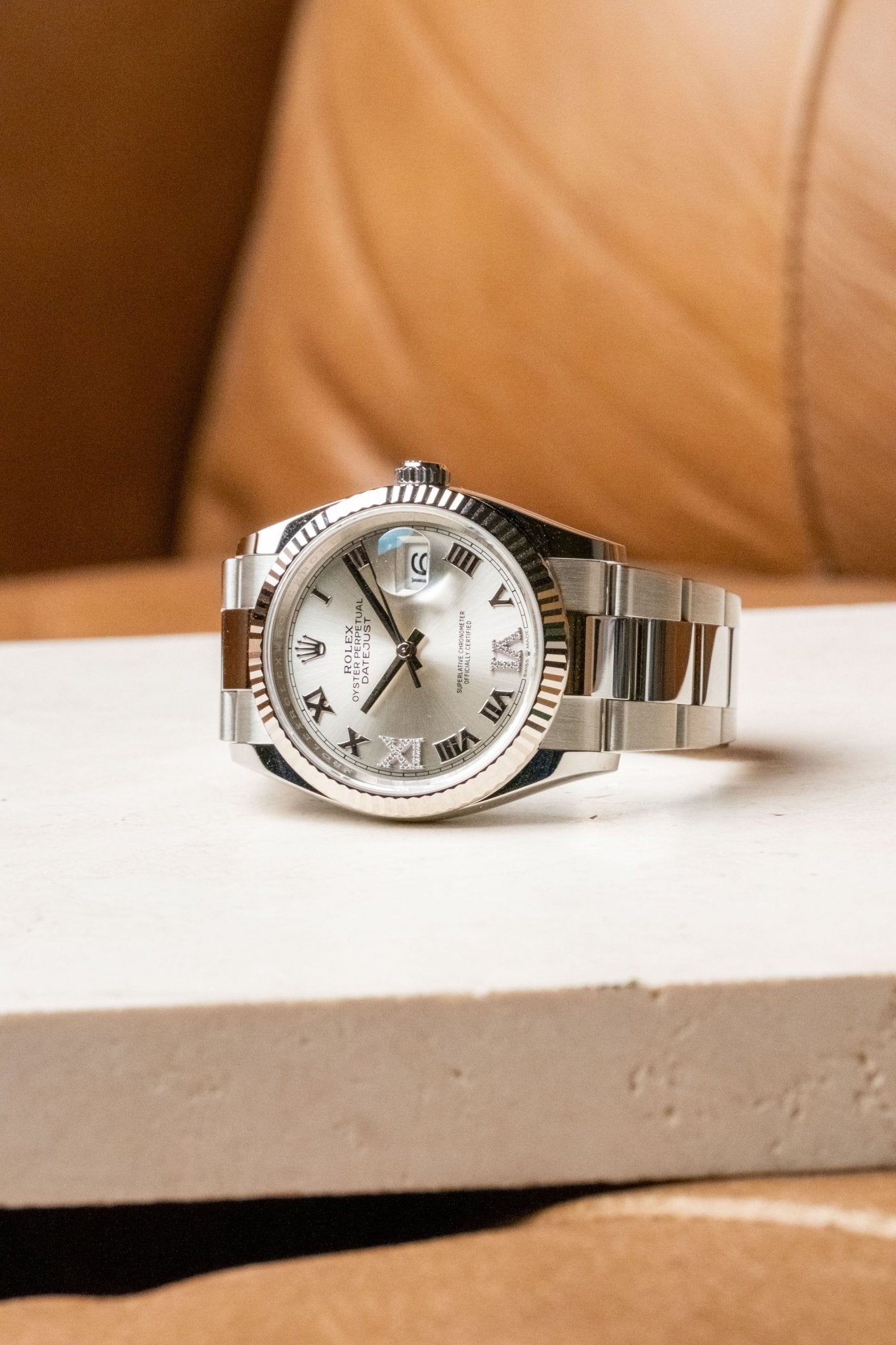
The Datejust comes in 36mm or 41mm cases, with either a Jubilee five-link bracelet or an Oyster three-link. A 36mm steel Datejust from the 2000s–2010s with a 3135 movement is the entry-level Rolex most people consider — you can find excellent examples AU$7,400–11,500. The 41mm modern versions (3235 movement) start higher, running at AU$13,000–17,000 depending on the bezel, dial colour, and bracelet configuration. The Datejust is Rolex's most versatile piece — it dresses up and dresses down without apology.
Daytona — The Collector's Grail
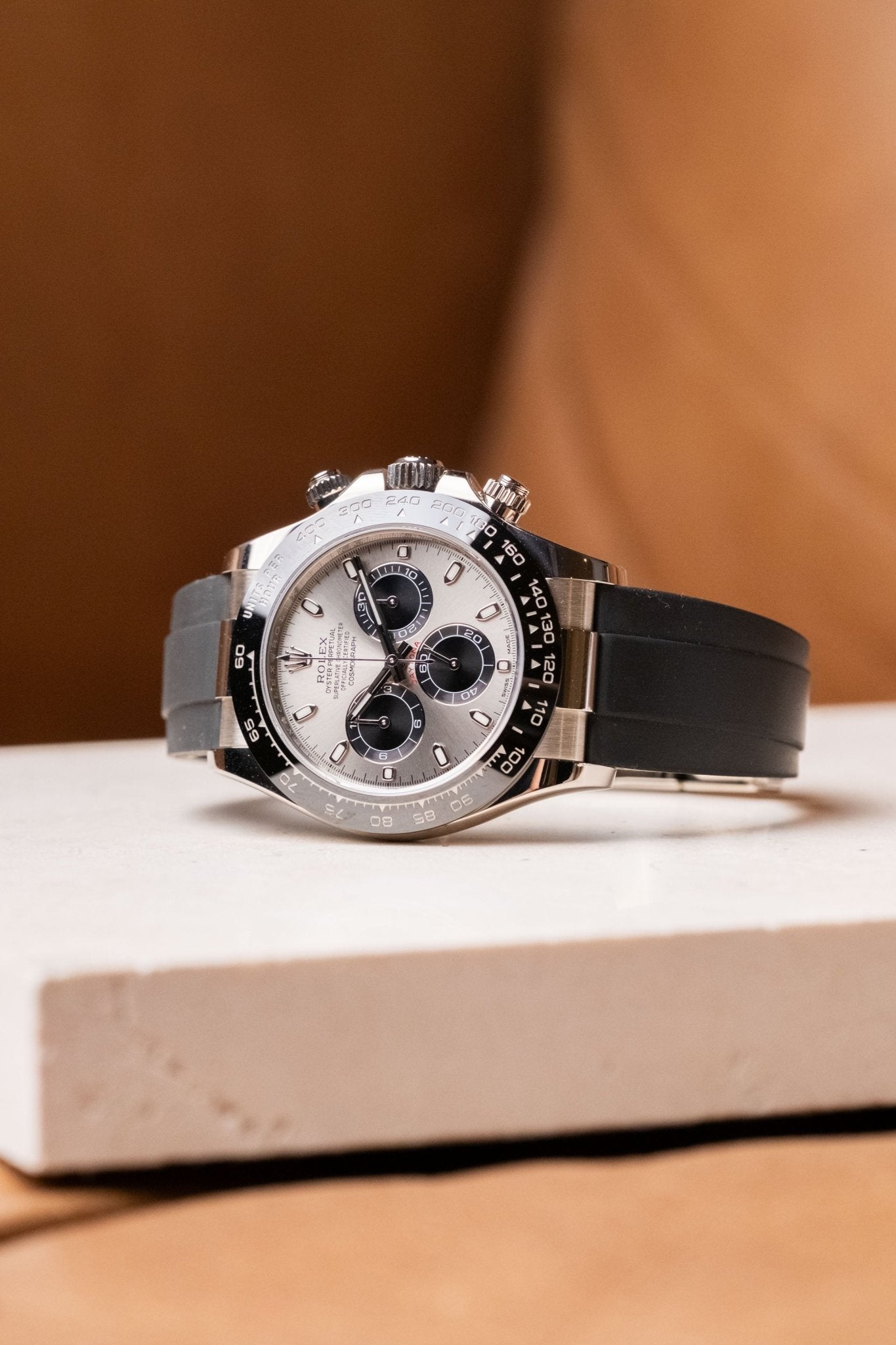
The Daytona is the hardest Rolex to find at an AD, the most expensive on the secondary market, and the most desired by collectors. It's a chronograph built for motorsport. The stainless steel version is the starting point, typically AU$44,000–54,000 for a recent generation example with papers. The vintage Paul Newman variant (exotic dial) is rare and expensive — AU$350,000 to well over AU$1,000,000 at auction. Why the high entry point? Rolex produces maybe 5,000–10,000 Daytonas annually across all variants, compared to 100,000+ Submariners. Supply is tight and collector demand is fierce.
If you're considering a Daytona, budget accordingly and accept that the secondary market is your only realistic path. Waiting lists at authorised dealers are effectively closed.
Explorer and Explorer II — The Underrated Picks
The Explorer is Rolex's minimalist statement — a 36mm steel watch with a simple dial, no complications, pure function. It's affordable compared to other models (AU$10,000–12,500 for a recent example), reliable, and doesn't scream for attention. The Explorer II adds a second time zone hand and a bezel for 24-hour tracking (similar function to the GMT-Master, but with a different character) typically running for AU$13,500–16,000. Both offer strong value if you want a Rolex that doesn't announce itself to the room.
Inspecting in Person: What to Do at the Viewing
If you're meeting a dealer or private seller to see the watch, bring a loupe (10x magnification), a jeweller's scale if possible, and your research notes. Spend time under good lighting — both loupe and naked eye. Give the crown 20-30 winds to start the automatic movement. Run the chronograph if it's a Daytona. Listen to the rotor. Ask to see the movement. Ask for the serial and reference numbers and cross-check them against your research. Take photos. If something feels off — anything — walk away. There's always another Rolex.
In Melbourne, a dealer showroom lets you spend time with the watch under professional lighting. Take advantage of that. If a dealer rushes you or seems uncomfortable with questions, find another.
After the Purchase: Insurance, Servicing, and Storage
You've authenticated, negotiated, and closed the deal. Now: insurance. A pre-owned Rolex worth AU$20,000 should be insured for its current market value. Most home and contents policies cover watches to a limit (often AU$2,500). You'll want a specialist luxury watch policy or a rider on your existing policy. Cost is typically 1–2% of the watch's value annually.
Servicing: if you don't have recent service history, plan for a full service within the next 12–24 months. A typical standard Rolex service in Australia costs roughly AU$1,100–1,350 at an official RSC, while chronograph models like the Daytona start closer at AU$1,600+, depending on calibre and required repairs. Storage: keep the watch in a safe place if you're not wearing it regularly. If you are wearing it, treat it as you would any mechanical watch — avoid extreme shocks and magnetic fields.
Frequently Asked Questions
Is buying a used Rolex worth it in 2026?
Yes — you get genuine Swiss engineering at 20–35% off retail, faster delivery than an authorised dealer (which is typically 1–3 years), and access to discontinued references. The trade-off is that you assume some responsibility for authentication and warranty is typically dealer-provided rather than Rolex's official coverage.
How do I know if a pre-owned Rolex is real?
Serial number verification on the rehaut, movement calibre inspection under a loupe, dial and hands quality, Cyclops magnification (2.5x with anti-reflective coating), bracelet end-link fit, and overall weight are the core checks. Bring an 8–10x loupe, ask the dealer to open the case back to inspect the movement mechanics, and when in doubt, purchase from a reputable specialist who guarantees authenticity. If you're uncomfortable, don't buy.
Do pre-owned Rolexes come with warranty in Australia?
It depends on how you buy, if you purchase through the official Rolex Certified Pre-Owned (CPO) program at a participating Auhtorised Dealer, the watch typically comes with a brand-new, official 2-year warranty Rolex CPO international warranty. If you’re buying on the standard secondary market, any watch less than 5 years old is still covered by its original 5-year Rolex factory warranty. For older watches, specialist pre-owned dealers usually offer their own internal mechanical warranties (typically 12 months), while private sellers offer no warranty protection.
Can I trade in my current watch toward a Rolex?
Many dealers offer trade-in programs. You sell your existing watch and apply the proceeds toward the new one. It's convenient but often nets you less than you'd get selling privately. Check both options before trading in.
What is the most reliable pre-owned Rolex to buy?
The Oyster Perpetual or Explorer with a 3130 movement is the ultimate answer for zero complications to break. However, the Datejust with legendary 3135 movement is a proven workhorse with decades of production runs. Any Submariner or GMT-Master II with proper service history is equally reliable. The Daytona's 4130 chronograph movement is also bullet-proof, but higher rarity means higher secondary prices.
How long does Rolex authentication take?
A full physical inspection with movement assessment typically takes 1–2 hours. However, full authentication, including cross referencing serial numbers against global-lost-and-stolen databases, typically takes 1 to 3 business days for formal written certification. If you're buying online factor in 3–5 business days for the seller to complete their inspection and ship. Plan accordingly.